Vancouver’s Hidden Rhythms: Where Slow Travel Meets City Soul
You know that feeling when a city surprises you? Vancouver did exactly that. I went looking for skyline views and coffee shops, but found something deeper—quiet corners in busy neighborhoods, where time slows and local life unfolds. This isn’t just about shopping districts or tourist spots. It’s about wandering Granville Island’s markets at sunrise, sipping tea in a tucked-away Chinatown café, and discovering how commercial areas can pulse with authenticity. Let me show you the Vancouver few travelers truly see.
The Pulse of Place: Why Slow Travel Fits Vancouver Perfectly
Vancouver is a city of contrasts, where glass towers rise beside ancient evergreens and ocean breezes drift through downtown streets. Yet beneath its postcard beauty lies a rhythm that rewards patience—a rhythm best discovered through slow travel. Unlike cities built for speed and spectacle, Vancouver thrives in the subtle: the murmur of a neighborhood bakery opening at dawn, the laughter from a backyard garden in Kitsilano, the quiet clatter of a Chinatown apothecary arranging dried herbs. This is a place where the urban and the natural coexist, inviting visitors not to rush, but to linger.
What makes Vancouver uniquely suited to slow exploration is its human scale. Despite being Canada’s third-largest city, it feels intimate. Most neighborhoods are walkable, with wide sidewalks, tree-lined avenues, and public spaces designed for gathering, not just passing through. The city’s cultural diversity adds depth to this experience. Over half of Vancouver’s residents speak a language other than English at home, creating a mosaic of traditions, flavors, and daily rituals that unfold in plain sight—if you’re paying attention. A Filipino grandmother selling homemade empanadas from a food cart, a Punjabi family picking up spices at an East Vancouver market, or an Indigenous artist displaying hand-carved jewelry at a weekend fair—these are not staged performances, but living moments of community.
Rushing through Vancouver means missing its soul. Tourists who stick to checklists often bypass the quiet parks where seniors practice tai chi at sunrise, or the unassuming storefronts where generations of families have run small businesses. The city’s commercial corridors—Granville Island, Main Street, Commercial Drive—are not just places to shop, but living ecosystems of local life. When you slow down, you begin to notice patterns: the barista who remembers your order, the bookstore owner who recommends a novel based on your mood, the street musician whose set changes with the weather. These are the threads that weave Vancouver’s urban fabric, and they reveal themselves only to those who move with intention and presence.
Slow travel in Vancouver is not about rejecting tourism, but redefining it. It’s choosing to return to the same café three mornings in a row, not because it’s famous, but because the light falls beautifully across the counter at 8:15 a.m. It’s sitting on a bench near False Creek and watching how the city wakes up—the cyclists, the dog walkers, the delivery trucks making their rounds. It’s understanding that a city’s heartbeat isn’t found in its monuments, but in its daily rituals. And in Vancouver, those rituals are everywhere, waiting to be felt, not just seen.
Granville Island: More Than Just a Market Stop
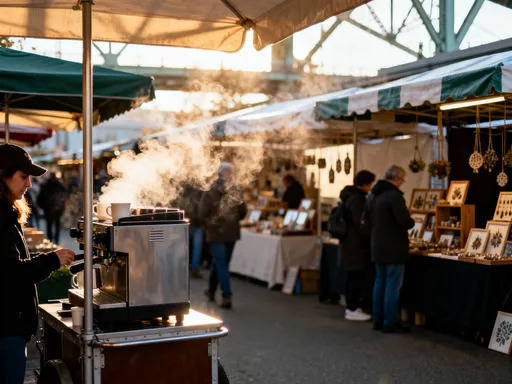
Granville Island is one of Vancouver’s most visited destinations, often crowded with tour groups and day-trippers drawn by its vibrant Public Market. Yet for all its popularity, the island reveals its true character only to those who visit beyond peak hours and venture beyond the main hall. At 7:00 a.m., when the fog still clings to the water and the first ferry glides in from downtown, the island feels like a different world—one of hushed activity, soft light, and quiet industry. This is when the artisans arrive, unloading handmade ceramics, fresh-cut flowers, and loaves of sourdough still warm from the oven. The air carries the scent of sea salt and baking bread, a combination as distinct as the island itself.
The Public Market is the heart of Granville Island, but it is not its only pulse. While most visitors focus on the stalls—drawn to the rainbow-colored jars of jam or the glistening smoked salmon—few linger long enough to notice the rhythm beneath. Vendors greet each other by name, sharing thermoses of tea and swapping stories from the week. A fishmonger hands a child a piece of cooked prawn with a wink. A florist arranges peonies with meticulous care, as if each bloom holds a small promise. These are not performances for tourists; they are the ordinary moments of a working community.
Stepping outside the market, the island opens into a network of lanes and docks where its industrial past still lingers. The net shed, a relic from the island’s days as a manufacturing hub, now houses artists’ studios with open doors. You can watch a glassblower shape molten color into delicate forms or listen to a violinist rehearsing in a sunlit workshop. Along the waterfront, benches face the city skyline, but few tourists sit long enough to stay. Locals do. They come with books, with dogs, with silence, watching the ferries cut through the gray-blue water. It’s here, in these unguarded moments, that Granville Island feels most alive—not as a destination, but as a place where people live, work, and pause.
To experience Granville Island slowly is to resist the urge to collect. It’s not about buying the most honey or snapping the best photo of the market sign. It’s about presence: tasting a sample of aged cheddar not because it’s famous, but because the cheesemaker explains how the milk is sourced from a single farm on Vancouver Island. It’s about asking questions, making eye contact, staying a little longer than expected. And it’s about returning—not just on the same trip, but perhaps in different seasons. In spring, the island blooms with tulips planted by volunteers. In autumn, the light slants low, turning the water to gold. Each visit offers a new layer, a new rhythm, a new reason to stay.
Main Street: The Heartbeat of Local Commerce
If Granville Island offers a curated glimpse of local life, Main Street embodies its unfiltered pulse. Stretching from False Creek to 33rd Avenue, this corridor is a testament to Vancouver’s enduring love for independent businesses. Unlike the polished uniformity of chain-lined avenues, Main Street thrives on variety—on the unexpected, the handmade, the deeply personal. Here, a vintage record store sits beside a zero-waste grocery, a tiny pottery studio shares a block with a decades-old hardware shop, and a café with no sign and an unmarked door serves the best pour-over coffee in the city. This is commerce as community, where every storefront tells a story.
Walking Main Street slowly means allowing time for discovery. Start in the morning, when the street is still quiet and the sun filters through the canopy of chestnut trees. Stop at a small café where the barista uses a manual brewer and asks how your day is going, not as a script, but as a real question. Order a single-origin roast and a house-made scone, then take it to a sidewalk table. Watch as neighbors wave to each other, as shop owners unlock their doors and sweep the steps, as a cyclist pauses to adjust a basket full of fresh baguettes. These are not fleeting moments, but the daily architecture of a neighborhood that values connection over convenience.
What sets Main Street apart is its resistance to homogenization. While other cities have seen their high streets overtaken by global brands, Main Street has held its ground. Independent boutiques offer clothing from local designers, repair shops mend shoes and bicycles with care, and bookstores curate selections based on owner passion, not bestseller lists. There’s a sense of stewardship here—a belief that a street should serve its residents, not just visitors or investors. This ethos is evident in the way shopkeepers remember regulars, in the seasonal decorations handmade by neighbors, in the community bulletin boards still filled with handwritten notes.
For the slow traveler, Main Street is an invitation to participate, not just observe. Browse a vintage clothing store where the owner shares the history of a 1970s coat. Attend a pop-up art show in a back room of a coffee shop. Chat with the woman running a tiny yarn shop who teaches knitting classes on weekends. These interactions are not transactions; they are exchanges of trust and time. And they reveal something essential: that commerce, when rooted in place and people, becomes a form of belonging. On Main Street, you don’t just shop—you connect.
Chinatown’s Quiet Corners: Beyond the Gate
Vancouver’s Chinatown is one of the oldest in North America, a neighborhood shaped by waves of immigration, resilience, and cultural preservation. Yet beyond the iconic gate on Pender Street, few travelers venture into its quieter lanes, where the real life of the community unfolds. Early in the morning, the streets come alive with activity that has little to do with tourism. Herbal shops open their doors, releasing the earthy scent of dried roots and bark. Steam rises from kitchen vents as cooks prepare dim sum for the lunch rush. Elders gather in Dr. Sun Yat-Sen Classical Chinese Garden, practicing qigong beneath the willow trees. This is a neighborhood that breathes on its own terms.
Chinatown has faced challenges, including economic shifts and gentrification pressures. Some historic buildings have been repurposed, and new developments sometimes overlook the area’s cultural significance. Yet the community remains deeply rooted. Family-run restaurants continue to serve dishes unchanged for generations. Associations and temples maintain traditions passed down through decades. Murals in hidden alleys depict stories of migration, labor, and hope—art that speaks not to visitors, but to those who live here. To walk slowly through Chinatown is to witness both its struggles and its strength.
The slow traveler can honor this legacy by engaging with care. Skip the souvenir shops selling mass-produced trinkets and instead visit long-standing businesses: a bakery known for its roast pork buns, a tea house where elders play mahjong, a pharmacy that blends traditional remedies. Order a bowl of handmade wonton soup at a no-frills diner where the menu is in Chinese and English, and the owner nods approvingly when you ask for extra chili oil. These choices matter—not because they are “authentic” in a performative sense, but because they support continuity.
There is a quiet dignity in Chinatown’s everyday rhythms. It’s in the way a fruit vendor arranges lychees in a perfect pyramid, in the handwritten signs in shop windows, in the sound of Cantonese spoken on a park bench. It’s not a museum, nor should it be treated as one. It is a living neighborhood, shaped by history but moving forward with purpose. To slow down here is to listen—not to narrate, but to witness. And in doing so, you become part of a deeper story, one that values presence over possession.
Commercial Drive: Espresso, Culture, and Community Vibe
Known locally as “The Drive,” Commercial Street pulses with a European-inspired ease, where sidewalk cafés, independent shops, and multilingual signs reflect its roots as a hub for Italian, Latin American, and Eastern European communities. On a Sunday morning, the street hums with a relaxed energy. Parents push strollers past bakeries selling fresh cannoli, readers unfold newspapers on park benches, and friends linger over double espressos at outdoor tables. There’s no rush here—just the slow unfolding of a community that values time as much as tradition.
The Drive invites you to sit, not just stroll. Enter a small press bookstore where the shelves are organized by theme—“Books That Made Us Cry,” “Revolution in 200 Pages,” “Cooking for One.” The owner remembers your name if you return, and might hand you a poetry collection “just because it felt right.” Around the corner, a deli displays house-made salumi, jars of pickled vegetables, and crusty bread from a local bakery. Order a sandwich and eat it on a bench in Nelson Park, where children play and dogs nap in the sun. This is not a curated experience; it is ordinary life, unfolding in real time.
What makes Commercial Drive special is its refusal to be polished. Graffiti covers some walls, potholes dot the road, and shopfronts are often unassuming. But this rawness is part of its charm. It’s a street that values substance over style, where a tiny record shop might host a live jazz set on a Tuesday night, or a community center offers free language classes. The multilingual signs—Italian, Spanish, German, Portuguese—speak to a history of immigration that continues today. Newcomers open restaurants, barbershops, and bakeries, adding layers to the neighborhood’s identity.
For the slow traveler, The Drive offers a lesson in presence. You don’t come here to check off attractions, but to absorb its rhythm. Order a coffee and stay for an hour. Talk to the woman selling handmade soaps at a weekend market. Attend a neighborhood festival where music spills into the street and strangers share food. These moments are not about consumption; they are about connection. And in a world that often feels fragmented, Commercial Drive reminds us that community can still be found on a city block, one espresso at a time.
Kitsilano and Broadway: Where Lifestyle Meets Local Economy
Kitsilano, or “Kits” as locals call it, is often associated with beach culture, yoga studios, and a polished, health-conscious lifestyle. And while the stretch along West 4th Avenue offers boutiques, juice bars, and upscale cafés, the true character of Kits lies in its quieter blocks—those just a few streets inland, where daily life unfolds away from the tourist gaze. Here, a neighborhood yarn shop hosts knitting circles, a decades-old ice cream parlor serves scoops in waffle cones made fresh daily, and a family-run hardware store sells everything from paintbrushes to fishing line.
The beach draws the crowds, but the residential streets reveal the community. Walk early in the morning, and you’ll see residents heading to the community center for swim lessons, parents biking kids to school, and gardeners tending to front-yard flower beds. The commercial strips along Broadway and West 4th are busy, but they are also layered. Behind the sleek storefronts are businesses that have survived for generations, adapting without losing their essence. A café that started as a hippie hangout in the 1970s now serves organic coffee, but still has the same mismatched chairs and bulletin board full of flyers for lost cats and piano lessons.
Slow travel in Kits means resisting the beachfront rush. Instead of joining the line at the popular brunch spot, explore a side street and find a diner where the cook knows the regulars by name. Visit a wellness shop that sells crystals and essential oils, but also hosts free meditation sessions. Stop by the Kitsilano Community Centre, where seniors play bridge, teens practice dance, and toddlers splash in the pool. These are not attractions; they are the quiet engines of neighborhood life.
What emerges is a portrait of balance—a community that values wellness without perfection, style without pretense, and commerce without compromise. For the traveler, this means discovering that even in a city known for its beauty, the most meaningful moments are often the simplest: a shared smile with a stranger, a perfectly toasted bagel with cream cheese, a bench with a view of the water and no agenda. Kitsilano teaches us that local life doesn’t need to be hidden to be precious—it just needs to be seen.
Putting It Into Practice: A Slow Traveler’s Mindset in the City
Adopting a slow travel mindset in Vancouver—or any city—requires a shift in intention. It means replacing checklists with curiosity, efficiency with openness, and documentation with presence. Start by choosing neighborhoods over landmarks. Instead of trying to “see everything,” pick one or two areas and return to them at different times of day. Visit Main Street in the morning, late afternoon, and again in the evening. Notice how the light changes, how the crowds shift, how the energy transforms. Each visit will reveal something new.
Engage in brief but genuine interactions. Ask a shopkeeper how long they’ve been in business. Compliment a baker on their sourdough. Sit in a park and observe without pulling out your phone. These small acts of attention build connection, even if fleeting. And they signal to the community that you are not just passing through, but pausing to see.
Leave room for spontaneity. Let a conversation lead you to a hidden courtyard. Follow a scent of roasting coffee down an alley. Accept an invitation to a neighborhood event, even if it’s not on your itinerary. Slow travel is not about control, but about receptivity. It’s understanding that the best moments are often unplanned—the elderly man playing accordion on a bench, the impromptu street performance, the shared laugh over a spilled coffee.
Finally, resist the urge to document everything. Put the camera down. Let the moment exist for you, not for an audience. Memory is a better souvenir than a photo. And in a city like Vancouver, where beauty is abundant but depth is earned, the real reward is not what you capture, but what you carry with you: the feeling of belonging, even briefly, to a place that moves at its own pace.
True travel isn’t measured in miles covered, but in moments felt. Vancouver teaches us that even in bustling commercial areas, there’s space to pause, listen, and belong—even briefly. By slowing down, we don’t just see the city; we feel its heartbeat. And sometimes, that’s the most unforgettable souvenir of all.